
PUERTO DE MAZARRÓN (MAZARRÓN)
Calle Antonio Cuello León, 15
30860 - PUERTO DE MAZARRÓN (MAZARRÓN)
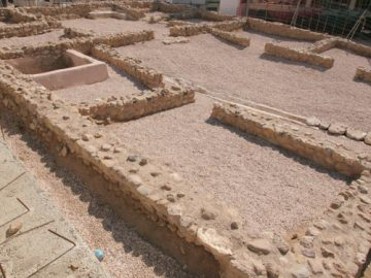
In 1990, at the back of the ancient port located in an area called La Era, a necropolis and some Roman single-family homes were excavated. The most complex houses had a hall, bedrooms, patio, kitchen and a cistern. They resembled classic Roman house models, with a central room around which the other rooms were centered. One of these houses was preserved by request of the Directorate-General of Culture, due to its scientific, historical and educational interest, and to the fact that it had been well preserved. The house mentioned has a surface of 300 m2 and is one floor, with the following structure: a large central room with a bench and plastered walls, interpreted as the triclinium, or hall. On each side of this room there are two symmetrical rooms which are entered through the main room. In the north side there is a large room with water channels or gutters wich have been identified as a possible atrium or vestibule. Around this patio the pattern of two symmetrical parallel rooms repeats, one serving as water storage with a 2 m deep pool, located next to what can be assumed the kitchen of this Roman house. The house of Calle Era formed part of the urban area of Port of Mazarrón in Roman times and was set up around another group of homes and a network of streets and small alleyways. These houses are the only clearly residential nucleus of the late Roman period studied to date. They were built at the same time that the salting factory was fully functioning and at its peak (the 4th-5th centuries A.D.). Rests of materials found in the homes, such as the high number of coins and the richness of the domestic goods indicate that the site belonged to a sector with significant acquisition capabilities. We assume that we are looking at a population nucleus dedicated to administrative or commercial activity connected to the salted fish industry, where people conserved Roman traditions, way of living and urban layout, although with a local market as indicated by materials and the structural system.
MAZARRÓN
Calle San Andrés, 12
30870 - MAZARRÓN
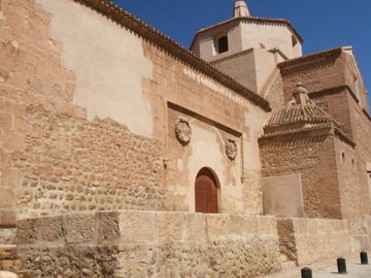
The San Andrés Church was built by the Marquis of Villena. From the original structure the main room has been conserved, distinguished for its handcrafted beauty, in the Mudéjar style. The rest of the building has been subjected to different restorations, giving it the architectural style that the church shows today. The interior still has some remains of parietal pictures and decorations. One of its two doors, the lateral one, corresponds to where the temple’s original entrance was, and as described by González Simancas during his early 20th century visit, it held the coat of arms of Guzmán, Cisneros, Enríquez and others, inscribed in circular flowers and fruits crowns and fruit in relief, in a style similar to the Junterón chapel within the Cathedral of Murcia. The San Andrés Church has been declared a Site of Cultural Interest.
MAZARRÓN
Plaza del Convento
30870 - MAZARRÓN
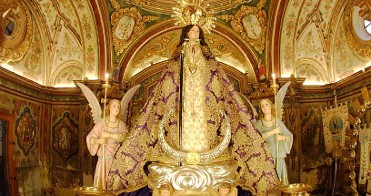
The church named Convent of La Purísima is associated with a significant event of this town, known as the Miracle of La Purísima. At the end of the 16th century, on November 17th, 1585, an unusual event occurred. According to the legend, some Corsican ships landed on the Mazarrón coast with the idea of pillaging the village, but their plans failed due to the Virgin’s intervention. In the 17th century, the Franciscans from Saint Pedro Alcántara founded a convent. In the church the lateral chapel stands out, believed to have been the old shrine, whose origin appears to date to the 16th century, although the architecture seen today is from the 18th century. The decoration of La Purísima Virgin’s Chapel, the patron saint of Mazarrón is very unique.
MAZARRÓN
Plaza del Ayuntamiento
30870 - MAZARRÓN
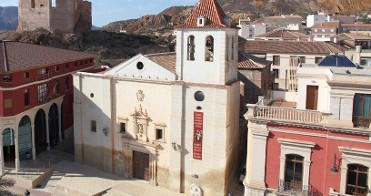
At the feet of Los Vélez Castle hill, and within the population nucleus that would extend around it, the San Antonio de Padua church is located very near the San Andrés Church (16th century). The Church of San Antonio, completed in the second half of the 16th century, was ordered to be built by the Marquis of Los Vélez to provide space for the religious rites of the workers who lived in the villa and depended on him. The temple is a very simple construction, subjected to different reforms and changes in time, especially during the 19th and 20th centuries, when the cupola of the transept was repaired and a new bell tower and vestry were built. During the Civil War (1936-1939) the Baroque altarpiece and some smaller altars were destroyed, later to be substituted by pieces created to reproduce the original ones. Inside, the cupola of the transept is distinguished for its pendentives with paintings of saints. On the main facade, a niche of San Antonio de Padua is distinguished in addition to Los Vélez coat of arms.
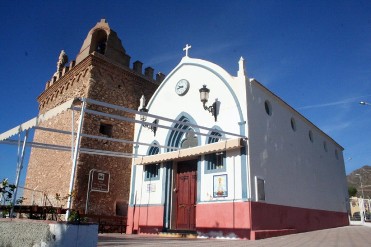
BOLNUEVO (MAZARRÓN)
Calle Lentisco
30877 - BOLNUEVO (MAZARRÓN)
In the mid- twentieth century, a chapel dedicated to the La Purísima Concepción in commemoration of the well knowned Miracle of the Virgin, was added to the Tower of the Horses. Although before this chapel was erected there were already some ancient buildings attached to the tower.
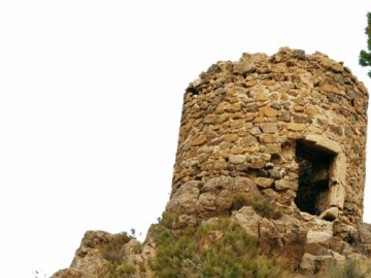
MAZARRÓN
Calle Miguel de Cervantes
30870 - MAZARRÓN
Elevated in a hill, the Molinete Tower can be found, also known as the Tower of the Catholic Monarchs. It is a watchtower in a circular shape, raised on a small promontory, close to Los Vélez Castle. The Molinete Tower was built by request of the Catholic Monarchs, who authorized it in 1490 as an appropriate structure for monitoring the coast. From its watchtower the coast could be controlled and measures could be taken for the area and the urban nucleus of Mazarrón to be protected against the frequent Barbary pirate invasions. The Tower is considered a Site of Cultural Interest.
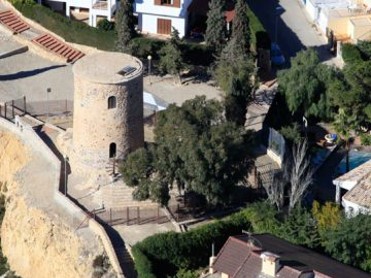
PUERTO DE MAZARRÓN (MAZARRÓN)
Calle Teide, 213 Urb. La Cumbre
30860 - PUERTO DE MAZARRÓN (MAZARRÓN)
The coast’s insecurity due to Barbary pirate threats caused many towers to be built along the coast in Mazarrón, allowing for people to live as fisherman and farmers on the coast. The Tower of La Cumbre, or Old Tower of the Port, or Tower of Santa Isabel is located on a tall hill which in its time would have dominated the Port. It is currently engulfed by the urban part of Puerto of Mazarrón. The tower is made on a circular base and slightly truncated circular body, with two vaulted sections. It has been declared a Site of Cultural Interest.
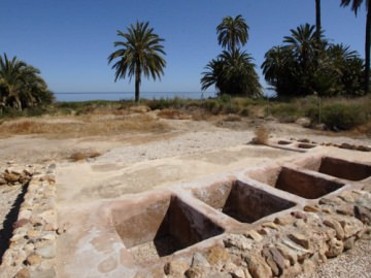
PUERTO DE MAZARRÓN (MAZARRÓN)
Avenida de El Alamillo
30860 - PUERTO DE MAZARRÓN (MAZARRÓN)
The Roman villae houses originated from the ancient agro-fishing character held by native Roman families. They consisted of a serf-sufficient inhabited nucleus, where frequently there was an infrastructure for exploiting farming resources, areas of artisan workshops, and in the villae in this area, industrial areas for salted fish preparation. This villa is a house that must have been built in the second half of the 1st century A.D. and was abandoned at the end of the next century, although perhaps continuing to be used until the first years of the 3rd century. Originally, it was a terraced construction differentiated into two parts: one residential area with corresponding thermal water pools; and another service or industrial part. This second part is now open for visitation, exhibiting the six salting basins dedicated to producing salted fish and Garum fish sauce along with a group of rooms around a patio. The villa’s economic activity would be focused on two sectors. On the one hand, the existence of basins leads us to believe it served a small-scale fishing business. On the other hand, this activity would be complemented with agricultural activities on their lands that could be irrigated thanks to the nearby El Alamillo Reservoir.
MAZARRÓN
Zona Minera de Mazarrón
30870 - MAZARRÓN
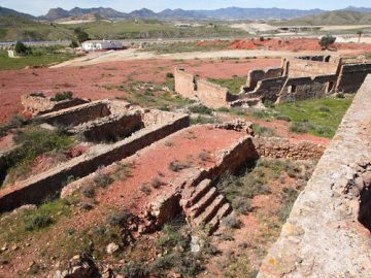
Alum is an aluminum and potassium sulphate, which was used in the 16th century as a mordant in fabric dyeing. The product also had other industrial, domestic and even medicinal uses. Data on alum production exists after the 15th century, when Enrique the IV granted the privilege of mining to the Vélez and Villena marquisates. The alum industry in Mazarrón went on growing until 1592, when the mines were closed as a result of declines in exportation to European countries. Starting in 1774, the mines’ activity was centered on alum waste and sediment (named “almagras”) treatment, which were used in that period for treating in the processing of tobacco. Remains of this activity in Mazarrón have been traditional in nature and operated on a small scale until recently. This production of what locals referred to as “alum,” more generally knowned as alum stone, a white coloured product used in barber shops as an “after shave” disinfectant. The old factory still maintains some parts of its facilities, such as some of the tanks, washing, and decantation basins, stone drying areas, a waterwheel base and ovens (for cooking the material). This is the oldest factory in Mazarrón, although there are two, more recent factories also dedicated to alum production. The red coloration of sediment is characteristic of these facilities (red ocher, referred to also as almazarrón in certain places) surrounding the facilities and giving them a particular look with this unique color, which has become emblematic and identifying for Mazarrón.
MAZARRÓN
Mazarrón
30870 - MAZARRÓN
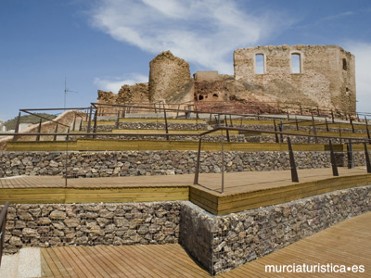
Under the Council of Lorca, a town called “The Alum Houses of Almazarrón” began to grow, where the Vélez laid the foundation of their Castle and the Marquis of Villena built his house. Both noble families moved into the area in the last decade of the 15th century, when Enrique the IV granted the privilege of exploitation of the alum mines to both marquisates. The Castle has an irregular shape, occupying an area of over 3.000 m2 which can be divided into two zones: the fort and the parade ground.The walls are a meter thick and are directly supported by the mountain’s rock. On the original internal structure of the Castle, the written testimonies of 'González Simancas’ visit to the Castle in 1903 describe that it held remains of several periods: paved areas, doors with worked limestone lintels, decorations created using red stucco, decorative elements, stairs, underground constructions, and other details which have disappeared or become hidden under an old mine excavated inside the fortified place. The Marquis of Vélez used to stay at the Castle occasionally during his sporadic visits, which was an everyday home for the governor of the villa. The building also had a small garrison in charge of defending the coast from the Barbary pirates’ attacks. During these threats the Castle also protected the population of Mazarrón, mainly composed of miners. The Vélez Castle has been declared a Site of Cultural Interest.
MORERAS / BOLNUEVO (MAZARRÓN)
Carretera de Bolnuevo (entrada junto a Desaladora Virgen del Milagro)
30877 - MORERAS / BOLNUEVO (MAZARRÓN)
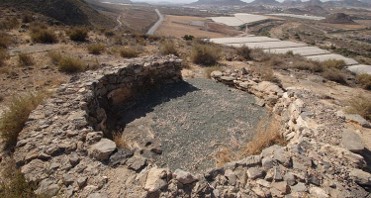
Cabezo del Plomo is one of the main settlements of the Neolithic – late Calcolithic age in the peninsula. It is a fortified town located on a plateau at the foothills of the Sierra de las Moreras. In the hill’s higher section the walls and circular cabins can be seen, while in the lower area the remains of a tholos tomb can be found, as an evidence of the megaliths in the area. Archaeological excavations have been performed by the University of Murcia Archaeology Department, directed by Ms Ana María Muñoz Amilibia during different campaigns, from 1979 to 1985. The site has been declared a Site of Cultural Interest. The town’s age can be identified between the end of the 4th millennium to the mid-third millennium B.C. The inhabited part of a 3,200 m2extension is surrounded by a wall in the town’s most vulnerable areas, in the west and south. The wall has been constructed using a technique which involves raising two stone courses filled with smaller rocks. To reinforce the line of defense, the wall was staked by attached defensive beams. The housing is found inside the premises, as circular-shaped homes with rock bases; the roofing would have been made with plant material. Among the materials located in the archaeological excavations, the rock elements for farm work and grain processing have important significance; remains of animal domestication and arrow points for hunting have also been found. This all seems to indicate that the population’s lives were modeled after farming and animal raising, although they also must have practiced hunting and harvesting from nearby areas, including the coast. The Cabezo del Plomo tholos is a funerary monument located outside the walls, at the foot of the populated area, and is the only lasting part of what would have been the necropolis. Built around the mid-4th millennium B.C., it is a trapezoidal chamber, delimited by ortostatos (vertical stones used in its construction) and surrounded by a circular structure. The entire outer part adopts a burial mound shape. It has no entrance corridor and the covering would have consisted of a false dome made of planked stones. The monument was created as an imitation of the circular homes or huts, an aspect which converts these monuments into some sort of “second home”. Some authors consider an eastern influence in the great similarity between these and the tholoi on the other end of the Mediterranean, near the Aegean Sea. They represent a system of collective burials which were successively built inside the funeral chamber. In the ritual, the cadavers were joined with their objects, deposited next to the deceased with the intention of them accompanying their soul to the next life. Some of the objects were functional, which the de-ceased would have used daily, while others served a more magical purpose.
PUERTO DE MAZARRÓN (MAZARRÓN)
Calle Cabo Oyambre
30860 - PUERTO DE MAZARRÓN (MAZARRÓN)
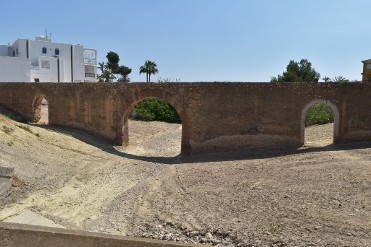
This work of hydraulic engineering possibly from the 18th-19th centuries, is made from limestone mortar and Stone, with bricks in the interior arch supports. The aqueduct provided water from El Alamillo’s source and carried it to the old farms located along the Lorentes streambed, allowing for the irrigation of the entire farmed area of El Alamillo. The aqueduct was in use until a few decades ago, when the water source dried up, and was followed by abandonment of the farmland. This structure is connected to other sections of the same buiding works, which are located throughout the area.
PUERTO DE MAZARRÓN (MAZARRÓN)

Calle La Torre esq. San Ginés (Museo Arqueológico-Factoría Romana)
30860 - PUERTO DE MAZARRÓN (MAZARRÓN)
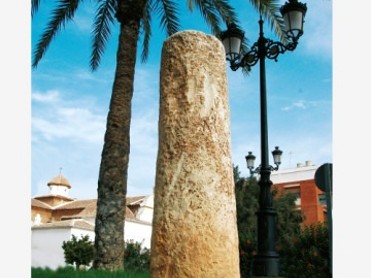
The Miliar term is applied to the posts, cairns or columns that were marking the distances in the ancient Roman roads. The Milestone of Mazarrón indicates the proximity of the Via Augusta road and has registered the following: "IMP.CAESAR DIVI F.AVGVSTVS COS XI TRIBUNIC.POTEST.XVI IMP.XIIII, PONTIFEX MAXIMVS.A LVCENTO EIOCROCAM.XXVIII MP REST". Translation: "Emperor Caesar Augustus, son of divinity, Consul XI times, tribunicia power XVI, Emperor XIIII, Pontifex Maximus, restored twenty eight thousand steps of the way from Lucentum to Eliocroca ".
MAZARRÓN
Monte Santa Catalina junto a Jardín Miguel Ángel Blanco
30870 - MAZARRÓN
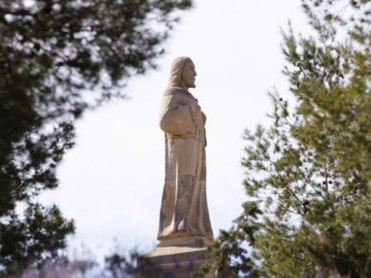
The Sacred Heart of Jesus in Mazarrón, located on the Santa Catalina hill, was the first to be erected in the Region of Murcia, blessed and inaugurated in May 1924. It was destroyed during the Civil War (1936-1939), and rebuilt in 1952 thanks to donations made by the people of Mazarrón, who brought together the necessary 18.000 pesetas. This type of large sculpture can be found in the majority of Catholic countries since 1899 when Pope Leo the 13th consecrated the whole Catholic world to the Sacred Heart of Jesus. In Spain this took place in May, 1919, when King Alfonso XIII attended the consecration at the Sacred Heart in Cerro de los Ángeles (Madrid). Since then, the entirety of the Spanish geography has been dotted with the construction of these sculptures.
PUERTO DE MAZARRÓN (MAZARRÓN)
Entre la playa de La Reya y playa de La Pava (Entrada por calle Argentina)
30860 - PUERTO DE MAZARRÓN (MAZARRÓN)
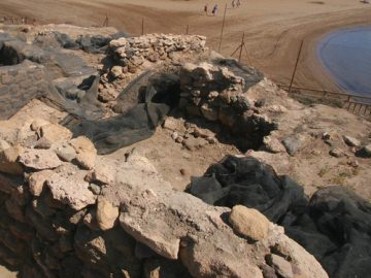
From the first centuries in the 2nd Millennium B.C. to the late 2nd century and beginning of the 1st century B.C. This small headland separating the beaches of La Reya and La Pava has been inhabited since the most remote of times, from Prehistory to Romanization. Thus, archaeological excavations need to be extremely careful and methodical when working in the area, which is exactly what a team from the Archeology Department of the University of Murcia is doing within a comprehensive Research Project that includes works in the old settlement of Mazarrón’s coastline. The settlement was first inhabited during the first centuries of the 2nd millennium B.C. due to the economic diversity of the Argaric groups in the area, who mainly worked in the exploitation of sea resources and supported sea and coastal navigation. Later, in the first millennium B.C. and towards the late 8th century and beginning of the 7th century B.C, the headland was used by Western Phoenicians as a trade point, and that was how things still were during the 6th century B.C. But the discovery of a silver-mining factory that operated during the 4th and 3rd centuries B.C. is perhaps one of the most relevant works currently being developed at the site. Said factory, whose metallurgical techniques were similar to the ones being performed at the time at Laurion’s Attica mines, is unique in the Western Mediterranean. The different parts of the building, which give evidence on the type of process followed, are still preserved and show that the metallic lead coming from the foundries near Mazarrón’s mines, was fire assayed in these facilities. This factory stopped being used when Kart Hadast was conquered by Rome in 209 B.C. However, towards the end of the 2nd century and early 1st century B.C. the place was again occupied, playing a similar role, although not as important as in the past and heavily dependant on the mining activity at Mazarrón under Roman administration. This activity continued until the change of Era, after which the headland was definitely abandoned and left uninhabited. This abandonment helped significantly to keep the place in good condition and that is exactly why we should protect it for the future.
EL ALAMILLO (MAZARRÓN)
Calle Punta Mala
30860 - EL ALAMILLO (MAZARRÓN)
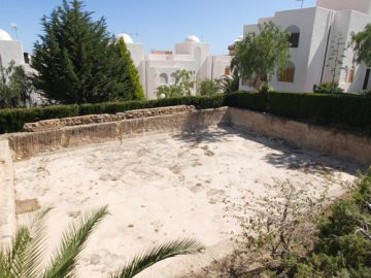
This is a Roman reservoir for water distribution that was already in use in the first century. Its entrance and exit aqueducts are also present. The pool is rectangular in shape and measures 15.30 m x 12.30 m, and is 1.35 m in depth, supporting a significant volume of water: more than 250,000 liters. The walls are made of rock and limestone, two of which are built against the ground and the other two are supported by buttresses. In the interior, the pool is plastered with limestone mortar and red colored blended ceramic (opus signinum mortar). In the structure’s interior joints, there are remains of some support beams which were meant to seal the reservoir, a common technique in Roman liquid containers, which can also be seen in their salting tanks. Next to the walls, a draining system can be found in addition to a stairway foundation, which provided access for cleaning the pool. The water conduit that deposited into the reservoir was positioned in the northeast corner, while the exit conduit lies on the southwest side and supplied water to the villages in the El Alamillo area and possibly to El Rihuete. The water came from a spring, which is dry today, located a few kilometers from the pool in the neighboring area of Las Balsicas. Some sections of the aqueduct bringing water to the reservoir can still be located. The aqueduct was built using similar techniques to those used for the reservoir. The canal measured 0.2 meters wide and its route was adapted to the land’s features of the Sierra del Algarrobo foothills.
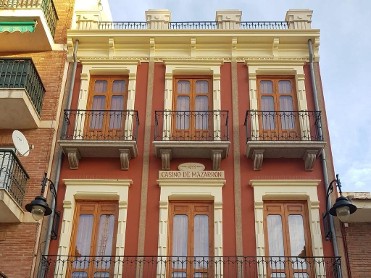
MAZARRÓN
Plaza del Ayuntamiento
30870 - MAZARRÓN
This eclectically styled, beautiful building is of great architectural and environmental interest, although there is little information on it. The exact date of its construction and the architect who designed it are unknown, although it has been estimated that it must have been built in the last decades of the 19th century. Some doubts exist as to whether it was built as a home or as a recreational facility (the casino). In the interior, a peculiar spiral staircase can be attributed to the Eiffel school, made of cast iron with very pronounced slope, intelligently designed but quite uncomfortable for everyday use. It is the only connection between the building’s floors.


