
CARAVACA DE LA CRUZ
Castillo, Santuario de la Vera Cruz
30400 - CARAVACA DE LA CRUZ
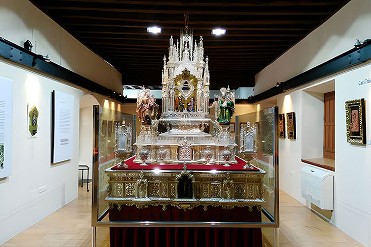
The building consists of two perpendicular naves preceded by a double gallery with semicircular lowered arches. It was designed during the first half of the 17th century. The museum has also a collection of metal works and paintings. Inside the art gallery stand out 6 oil paintings on panel painting from the 16th century. These are original works of Hernando de los Llanos, a painter who was a disciple of Leonardo da Vinci. Another work worthy of mentioning is the oil on canvas Curación de Tobias (the healing of Tobias), made by Rafael Tegeo from Caravaca, who was a personal painter of Queen Isabel II and one of the best Spanish neoclassical portraitist from the 19th century. In the metalwork section we can find the artwork Custiodia-Ostensorio de la Cruz (The Custody-Hostensory of the Cross) from the beginning of the 16th century; the artwork Portacruz de los Baños, a present from Luis Fajardo, the second Marquis of Velez; and the silver gilt box, donated towards the end of the 14th century by the master of the Order of Santiago, Lorenzo Suárez de Figueroa. Standing as an important piece in the museum, La Casulla de Chirinos, a Muslim tiraz adapted to the shape of liturgical ornament, is believed to have been carried by priest Chirinos at the time of the miraculous apparition of the Cross.
MURCIA


Plaza Cardenal Belluga
30001 - MURCIA
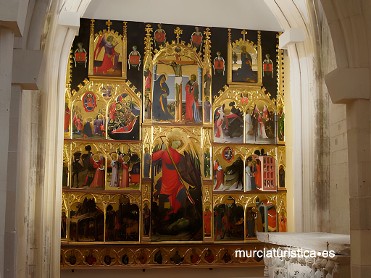
Museum of the Cathedral.
MURCIA
Plaza. San Agustín, 3
30005 - MURCIA
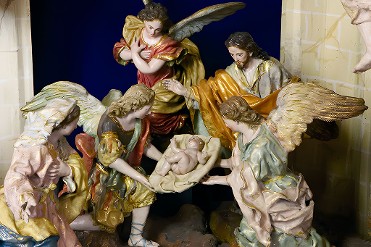
Salzillo Museum. It was opened in 1960 and deeply remodelled in 2002 by the architect Yago Bonet Correa. It is a mixture of typologies: we have the Baroque Art which is still alive under the watchful eye of the Church of Jesus, see of the Brotherhood of the same name and which was declared artistic historical monument from 1935; and also the Contemporary Art, created in 2002 by this architect. A mixture of styles which coexist in perfect harmony. In the outside, in the lateral façade we find a magnificent portal which belongs to the ancient Renaissance Palace of Riquelme (previously located next to the Plaza de San Bartolomé and currently disappeared). It is meaningful that this family also ordered Salzillo the sculpture set of the nativity scene in 1776. This project kept him busy until his death in 1783. In the church of Jesus the Nazarene, famous thrones of Francisco Salzillo are exposed and walk in file on Good Friday morning: "La Caída" (1752), "la Verónica" (1754), "San Juan" and "la Dolorosa", made between 1752 and 1777, "la Santa Cena del Señor" (1763), "la Oración en el Huerto" (1752), "el Prendimiento" (1765) and "Cristo amarrado a la columna" or "Los Azotes", which was made between 1776 and 1777 and the last throne of this maker of religious images. The carving which names the Brotherhood, "Nuestro Padre Jesús" (Our Father Jesus), an anonymous carving of the 16th and 17th centuries and the one which gives its own name to a brotherhood, is the only one that wasn't made by Salzillo. 556 figures, which form the famous "Belén" (Nativity scene) also highlight. These figures were ordered to Salzillo by the marquis of Riquelme, and also an interesting collection of original clay sketches.
SAN JAVIER

Ctra. Cartagena s/n
30730 - SAN JAVIER
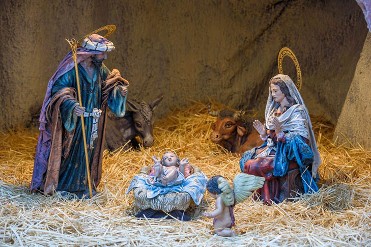
MUSEUM OF NATIVITY ART The Museum of the Nativity of Spain, located in the same building as the Local History Museum, showcases the most characteristic aspects of Christmas art in three rooms. The first section presents the joyful Mysteries of the life of Jesus. In the second section, various traditional scenes and occupations typical of the Region of Murcia can be observed. The third section features an international exhibition of Nativity art. The Nativity scene is displayed each Christmas in the Plaza de España in San Javier. The collection comprises approximately 500 Nativity figures.
CARAVACA DE LA CRUZ
C/ Gregorio Javier, 21
30400 - CARAVACA DE LA CRUZ
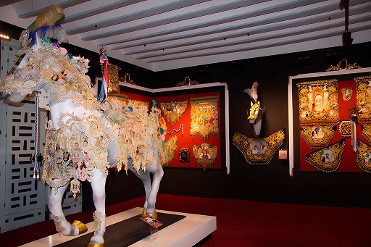
This space dedicated to the Caballos del Vino (Wine Horses) is located in the old house of the family Muso Muñoz Melgarejo, from the 18th century, which has been totally restored. It is a journey through its origins until the present, where all aspects of the festivity are represented: the bareback horses, the design, embroidery and piece of harnessing, the Race... The aim is to proudly transmit and spread, through several rooms and audiovisuals, the roots and the present situation of a celebration that is currently a Intangible Cultural Heritage. Telephones: Reservas: 968 705 620 Museo: 868 185 096
CIEZA
C/ Cánovas del Castillo, 7
30530 - CIEZA
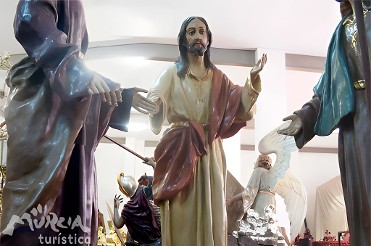
Built in 1970, it houses inside an important part of the heritage of the brotherhoods of the Holy Week of Cieza: images, thrones, banners, lanterns, balles, costumes, etc. The lower floor is devoted entirely to the steps that parade in our processions. On the upper floor, the dependencies of the different brotherhoods and the Board of Brotherhoods itself are distributed, as well as the Board and Exhibitions Room, in which it can be contemplated.
JUMILLA
Convento de Santa Ana del Monte
30520 - JUMILLA
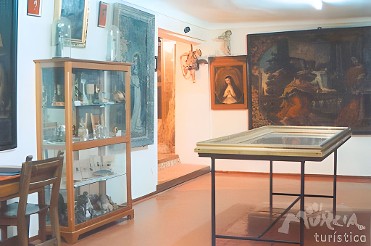
Situado en el paraje que le da nombre, consta de reliquias y objetos singulares traidos por los padres franciscanos en sus viajes misioneros por todo el mundo. Destaca de entre toda la colección un Cristo de Salzillo, los relicarios, la capilla con sus retablos, diversas pinturas sobre todo del barroco, etc. Ofrece también objetos de carácter etnológico entre los que se encuentran artesas, instrumentos de matanza y objetos típicos de la vida cotidiana del convento y de uso popular. Cuenta con una importante biblioteca monacal.
ALHAMA DE MURCIA
C/ Fuente Blanca, 18
30840 - ALHAMA DE MURCIA
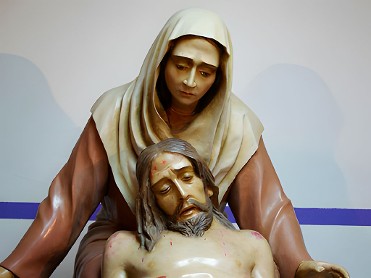
It is the permanent exhibiton of the religious scenes (pasos) of the Easter brotherhood "Archicofradía de Nuestro Padre Jesús Nazareno". Here you can see 28 images, some of them are part of the floats which represent the last 7 words of Jesus on the Cross. Also, the full scale photographic negatives, of the Shroud of Turin are on display, and the copies of the Sudarium of Oviedo and of the Holy Grail.
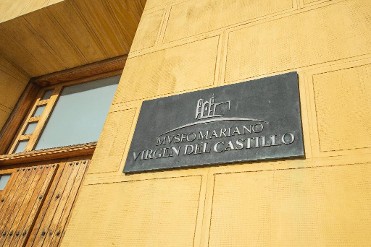
YECLA
Explanada del Santuario del Castillo.
30510 - YECLA
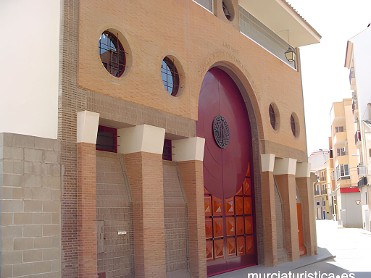
JUMILLA
C/ Portillo de la Glorieta, 24
30520 - JUMILLA
El museo cuenta con una colección cercana a los 150 objetos relacionados con el Arte Sacro y la Semana Santa de Jumilla. Pasos: Ecce-Homo (González Moreno, 1942), Descendimiento de la Cruz (José Planes, 1952), Aparición a Santa Tomás (Hernández Navarro, 1985), Negación de San Pedro (Hernández Navarro, 1993).


