


Lugares de interés
La Manga San Javier (La Manga del Mar Menor)
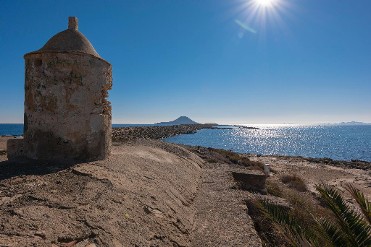
The Estacio Cistern. As in all arid regions, since prehistoric times, humans have devised methods to harness the scarce water resources available, either by storing rainwater or extracting it from the ground through wells. Thus, in the regions of Campo de Cartagena and Mar Menor, the presence of these systems, generally for family consumpiton, is widespread in rural areas, next to homes or scattered in ppulation centers near the beaches. Even lighthouses had their own cisterns, as in the case of Estacio. Introduced by the Romans, it was the Arab who expanded their use. In fact, the word "aljibe" derives from the Arabic term "Al Yibab". They are underground deposits generally in a cylindrical shape, waterproofed with a layer of mortar. On the outside, a wellhead was installed, topped by a small turret or chapel, with a door and a pyramid-shaped roof. Inside the turret, a wooden pulley was placed from which a rope with a bucket hung. The Estacio Cistern, built to supply water to the families and domestic animals of the two lighthouse keepers who provided service to the lighthouse, was constructed following the model of a cylindrical vault and an exrterior turret, very common in the Campo de Cartagena. The storage system began in a pool, collecting rainwater, where it was allowed to settle for some time to remove impurities. The water was channeled from the pool and passed into the cistern through a grille.
Active tourism
Cabo de Palos (Cartagena)
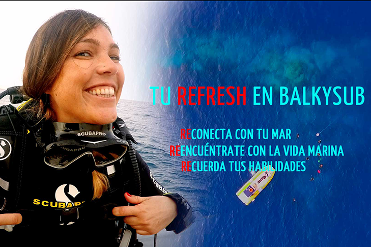
Balkysub Diving Operations somos una Escuela y Centro de Buceo PADI 5 Star CDC con bases en Cabo de Palos y Madrid. Nuestra filosofía de principal es el Buceo Sostenible. Disfruta de tu tiempo libre en un ambiente relajado y divertido. Nuestras prioridades son el respeto por la vida marina, por tus compañeros y la práctica de un buceo responsable y seguro. La Escuela de buceo Balkysub te da la bienvenida a tu casa para disfrutar de tus vacaciones de buceo en familia. Siempre tenemos lugar para los niños en nuestros programas Junior de buceo y snorkeling, es seguro y divertido, donde disfrutaran de toda la fauna de la costa cálida. Ya son famosos nuestros cursos PADI de buceo, ya sea en madrid, la manga y/o cabo de palos. Todos los días buceamos en Cabo de Palos, en la reserva (bajo de dentro, piles, las agujas, etc.) donde la fauna no dejará indiferente o en la zona de la costa(nuestras maravillosas calas y fondos donde nunca sabes lo que puede aparecer, siendo un privilegiado que puedes encontrar la historia sumergida) y también en los pecios (nadir/ naranjito, o el conocido sirio) esos maravillosos barcos hundidos que hay en toda la zona, que cuando los ves puedes notar como la historia te invade por el cuerpo sintiendo la nostalgia de las historia que vivió ese navío. Y si quieres una experiencia inolvidable de un vida a bordo Cada año organizamos expediciones de buceo en otros mares como Mar Rojo, Maldivas, Mexico, Filipinas, etc. Lugares en los que nos divertimos y disfrutamos de buceos en aguas cálidas y de excelente compañía. ¡¡TE ESPERAMOS!!

Routes
La Manga Cartagena (La Manga del Mar Menor)
Restaurants
Cabo de Palos (Cartagena)
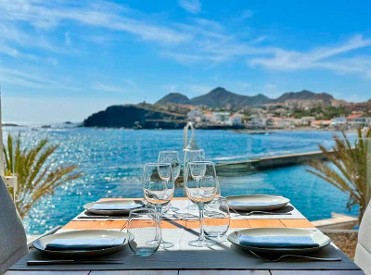
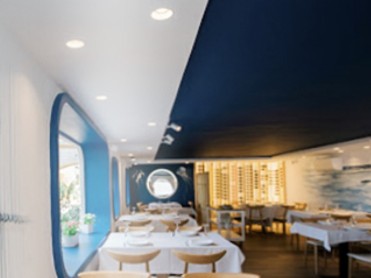
Una manera de disfrutar, todo el año, el entorno privilegiado de Cabo de Palos. Ubicado en el corazón del puerto de Cabo de Palos contamos con distintos espacios, dos terrazas en primera línea del paseo marítimo y en el interior dos salones en planta baja y planta de arriba respectivamente, ofreciendo desde cualquier rincón unas vistas espectaculares. Todo ello junto con la decoración y el ambiente, surgido de forma natural, hacen de Bocana de Palos el lugar perfecto para vivir una experiencia que apetece disfrutar una y otra vez irremediablemente. Fusión de tradición e innovación. Proponemos una oferta gastronómica que logra combinar la cocina tradicional y local con propuestas innovadoras, fruto de una cuidada fusión internacional, creando una carta diferente, cimentada sobre la máxima irrenunciable del empleo de género fresco y de primera calidad.
Lugares de interés
La Manga Cartagena (La Manga del Mar Menor)
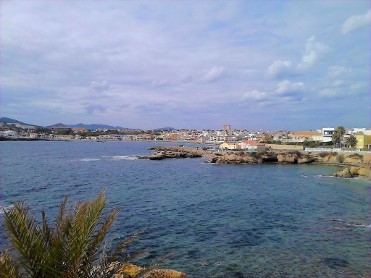
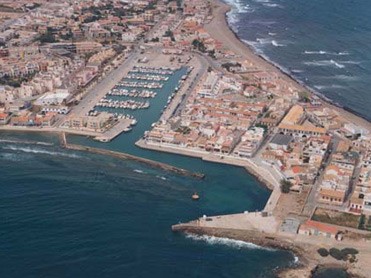
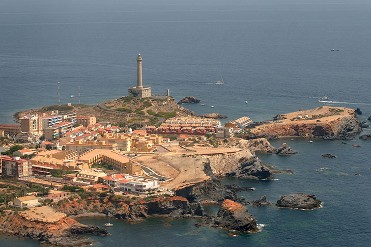
The town of Cabo de Palos, located around the promontory that gives it its name, was originally a fishing village that today continues to combine this traditional activity with tourism, following the birth and development of La Manga del Mar Menor as a destination for sun and beach tourism. The town is organised around its beautiful port, where the fishing boats are mixed with those dedicated to diving, a growing activity, as the Cabo de Palos and Islas Hormigas Marine Reserve has been recognised as one of the best in Europe. The port of Cabo de Palos also has a peculiarity that gives it charm, because unlike the usual, its dock is introduced into the land, since in its construction in the 70s an area called La Charca, low and flooded, was used to place there a safe port and sheltered from storms. From the port starts the Paseo de La Barra, adorned with the terraces of its cafés and restaurants, an ideal place to taste the typical dish of the area: the caldero, made with rice and fish. At the end of this promenade is the Muro de la Sal (Salt Wall), where the boats used to load the precious product obtained from the nearby Marchamalo salt flats. This is the beginning or end of a path that skirts the cliffs of the cape, offering a spectacular landscape of coves, where the blue of the sea contrasts with the dark tones of the rocks, making them ideal for snorkelling, and which takes us to its most emblematic spot: the lighthouse. The lighthouse, situated on a promontory that rises and sinks into the sea, has its origins in the old watchtowers. The 50-metre high tower stands on a square building, which was designed as a lighthouse keepers' school as well as a residence. Its 80 metres above sea level make it the highest in the east and the icon of the whole area. From this strategic point we can dominate the entire coastline, which, starting from Levante Beach and extending towards La Manga, becomes low and sandy. On the way back to the port you should not miss the Plaza de la Virgen del Mar, which is surrounded by whitewashed houses and on summer nights is full of atmosphere on its terraces.
Monuments
La Manga Cartagena (La Manga del Mar Menor)
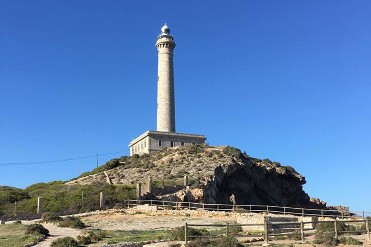
The lighthouse of Cabo de Palos is located on an approximately 600 meters-wide small peninsula in the municipality of Cartagena. Back in its time, there was a watchtower where the lighthouse is currently located. The simple structure is defined by its surveillance function as well as the lighthouse-keepers school which was housed in its base. The construction started in 1863 and the lighthouse was first lit on the 31st January, 1865. The building rises 30 meters above sea level, according to Leonardo de Tejada's project. Ashlar stones brought in from a quarry located in the town of Sabinar were used as building material. It has a prism-shaped base of 20 meters on each side and 14 meters high with rusticated edges. In the middle of the base, above an octagonal shaped pedestal rises the 54 meters high tower. It adopts the form of a Tuscan order column and its capital consists of various corbels that hold up a circular cornice with an openwork parapet in a shape of a balustrade. Above, there is a cylindrical tower where the lantern is built in. Nowadays, it has a beacon with a range of 24 miles.

Actividades en la naturaleza
La Manga del Mar Menor
PAISAJE PROTEGIDO ISLAS Y ESPACIOS DEL MAR MENOR ¿Te gustaría participar en un proyecto de ciencia ciudadana? Celebra el Día Mundial de las Aves Migratorias acercándote a nuestro Punto Móvil de Observación de Aves y colabora en el censo y la recopilación de datos sobre las especies que habitan o están de paso por este Espacio Natural. Una actividad para reforzar el compromiso de la sociedad con el entorno natural. SIN INSCRIPCIÓN PREVIA LUGAR: SALINAS DE MARCHAMALO (APARCAMIENTO)
Beach
Cabo de Palos (Cartagena)
Cartagena
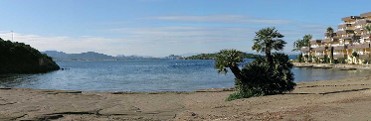
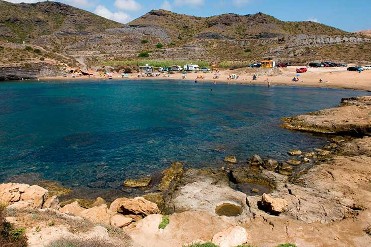
Urban beach. This beach is located in Cabo de Palos, a peninsula 400 m wide. The seafloors surrounding the village are one of the most important natural reserves in the Mediterranean Sea. There is a bus stop and buses connecting Cartagena and La Manga (a service offered by the company Alsa) and Murcia and La Manga (a service offered by Alsina Graells).
Beach
Cabo de Palos (Cartagena)
Desde las playas del Parque Regional de Calblanque hasta la península de Cabo de Palos, todo el litoral se encuentra festoneado de pequeñas y bonitas playas y calas de mayor o menor tamaño, desde las más amplias como Cala Flores o Calafría y Cala Túnez, a los pies del faro, y otras que son apenas entrantes rocosos, a los que se puede acceder en algunos casos por escalerillas que parten desde el bonito sendero que rodea el cabo. Todas ellas son ideales para la práctica del snorkel y ofrecen un magnífico baño en sus aguas trasparentes. Así, tomando como referencia de partida Cala Reona, situada entre Calblanque y Cabo de Palos, siguiendo la línea de costa encontramos: Playa del Descargador Cala Flores Cala Medina Playa de La Barra Playa del Cura Cala Mayor Cala Botella Cala del Canto Colorado Cala del Muerto Cala Roja (también llamada de la Escalerica) Calafría Cala Túnez (también llamada Cala Cuna) Cala La Galera Cala Hierro (también llamada Cala del Pato)
Holiday accommodation
Cabo de Palos (Cartagena)
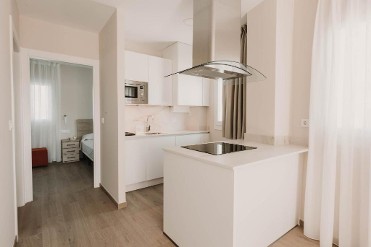
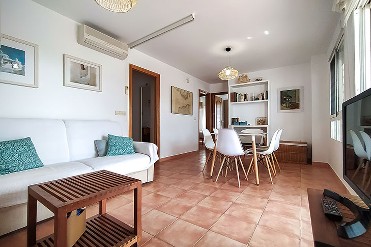
Apartamento de dos dormitorios con una espléndida terraza sobre los jardines de 129m2 con vistas, cuenta con un mobiliario de primera calidad y una amplia cocina, tiene aire acondicionado en habitaciones y salón, wifi y plaza de garaje incluido, cuenta con todos los electrodomésticos habituales en una vivienda.


