
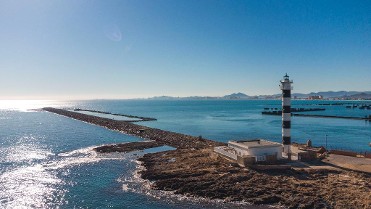
LA MANGA SAN JAVIER (LA MANGA DEL MAR MENOR)

Km. 13
30380 - LA MANGA SAN JAVIER (LA MANGA DEL MAR MENOR)
El primitivo faro se construyó en 1862 sobre una torre vigía del siglo XVI, que junto con otras 29, defendían las costas murcianas de los ataques corsarios. Hasta que se automatizó el faro en 1929, el servicio del faro era llevado a cabo por dos fareros. El actual faro se inauguró en 1971, tras ser demolido y construido de nuevo para adaptarse a la nueva normativa. Se trata de una torre cilíndrica de hormigón armado de 29,20 m de altura. . La parte superior está rematada con dos cámaras de servicio e iluminación sobre dos plataformas con barandilla de acero inoxidable. El sistema de iluminación está equipado con una linterna que emite cuatro destellos de luz blanca cada 20 segundos con señal de 4º orden y alcance de 22 millas.
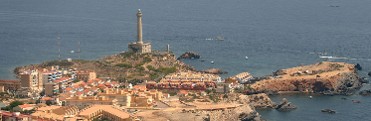
LA MANGA CARTAGENA (LA MANGA DEL MAR MENOR)
30780 - LA MANGA CARTAGENA (LA MANGA DEL MAR MENOR)
Cabo de Palos is a peninsula of about 600 meters in length of volcanic origin, oriented from east to west, which forms the westernmost part of the Betic system that here sinks into the sea, giving rise to the low seas and the nearby islands. The low and sandy coastline, in its section of La Manga, becomes steep and rocky when rounding the cape, opening up into small coves, hollows and nooks created by erosion, housing rich habitats of flora and fauna. Connecting the port of Cabo de Palos with its lighthouse, we find a very special walk that runs along the cliffs of the town and each of its wonderful coves. Small ladders facilitate access to each one of them, authentic diving and snorkeling paradises. It is not recommended to leave the marked route. The cliffs and coves of Cabo de Palos are truly amazing.
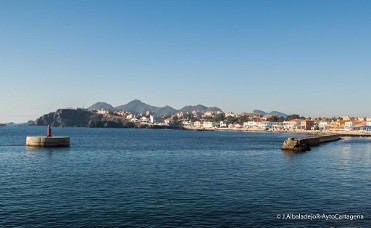
LA MANGA CARTAGENA (LA MANGA DEL MAR MENOR)
Cabo de Palos
LA MANGA CARTAGENA (LA MANGA DEL MAR MENOR)
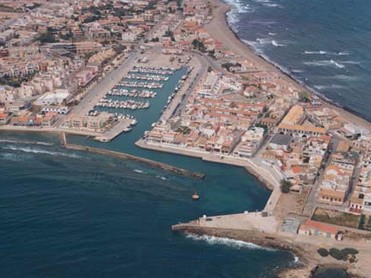
The port is the central axis around which the town of Cabo de Palos is agglutinated. There is continuous activity here, both on the part of the fishermen who continue to maintain their traditional arts, as well as those who enjoy nautical leisure in its different varieties, especially diving. Diving in the depths of the Cabo de Palos and Islas Hormigas Marine Reserve, recognised as one of the best in Europe, is an experience and a privilege, which is why there is a constant coming and going of boats from the diving centres and schools that have their headquarters around the dock. The dock splits the Paseo de la Barra in two. To the right is Zeneta, which still has the old buildings of low houses with their porches overlooking the sea, giving it the essence of a fishing village. On this side of the port is also the church, of contemporary architecture that replaced the old one, and the Cabo de Palos Documentation and Exhibition Centre, where we can learn about and discover the extraordinary diversity of its seabed, the history of the great shipwrecks of Cabo de Palos and the formation of the Mar Menor. The left-hand side of the Paseo de la Barra is more crowded with residents and visitors who enjoy the terraces in the cafés and restaurants where they can sample the local gastronomy, the star of which is the "arroz caldero" (rice stew). From the end of this promenade starts the path, which runs along the coves and cliffs to its famous lighthouse. In the absence of a large central square in the town, its harbour acts as such, as the important events in the life of Cabo de Palos take place around it, such as the maritime procession of the Virgen del Carmen or the procession of the Cristo de los Pescadores on Maundy Thursday.
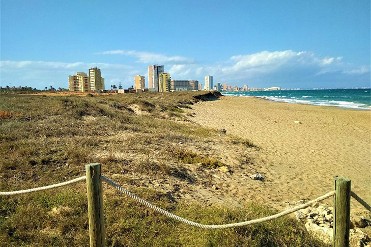
LA MANGA CARTAGENA (LA MANGA DEL MAR MENOR)
Gran vía de la Manga s/n
30370 - LA MANGA CARTAGENA (LA MANGA DEL MAR MENOR)
At the intersection between Cabo de Palos and La Manga, is the Espacio Litoral de Las Amoladeras, an area free of urbanization as it is protected by its natural, landscape and archaeological values. This space has important protection figures: - ZEPA of the Mar Menor - LIC Open Spaces and Islands of the Mar Menor - Protected Landscape Open Spaces and Islands of the Mar Menor - RAMSAR Wetland of International Importance - Area of ¿¿Special Importance of the Mediterranean ZEPIM In it we can find autochthonous species, such as the Margarita de Mar (Asteriscus marimus), the Albardín (Lygium spartum), the Taray (Tamarix sp.) Or the Date Palm (Phoenix dactylifera). On its border with the beach there are also dune systems whose importance lies in the fact that they consolidate the beach and prevent the loss of sand, in addition to giving shelter to many species of fauna and flora, some of them in danger of extinction in the Region of Murcia , such as the dune juniper (Juniperus turbinata). The dune systems are dynamic and fragile environments, being in the coastal area of ¿¿Las Amoladeras one of the last dune systems present in the coastal strip of La Manga del Mar Menor. It is also worth noting that bird species such as avocets (Recurvirostra avosetta), terns (Sterna albofrons), plovers (Charadrius alexandrinus), gray herons (Ardea cinerea) and flamingos (Phoenicopteus roseus) nest in this space. This protected space receives its name from the archaeological site of the eneolithic period that is found here. In it, a large number of grinding stones were found, such as hand mills, to crush cereals, used by the settlers who about 5000 years ago, at the beginning of the Metal Age, settled in this area, surely attracted by the availability of natural resources. In the Archaeological Museum of Cartagena a good number of the archaeological remains found in this site are preserved and exhibited. We can enjoy this Coastal Area on the route from La Manga to Cabo de Palos, also known as the 10,000-step path, with the variable in this section of traveling along the shores of Las Amoladeras beach.
LA MANGA CARTAGENA (LA MANGA DEL MAR MENOR)
LA MANGA CARTAGENA (LA MANGA DEL MAR MENOR)
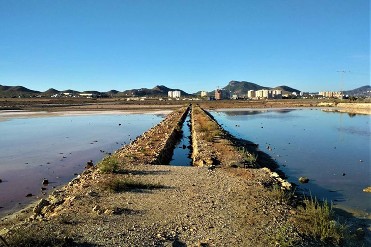
At the end of the 19th century, in the surroundings of Cabo de Palos, favored by its lake environment, an incipient salt industry was established in those known as Salinas de Marchamalo. The system of exploitation was based on taking advantage of the natural insolation that caused the evaporation of the water in the ponds or lagoons, leaving the salt residue and thus obtaining the white gold: salt. During the boom years of this industry, a series of buildings and facilities necessary in the production process were built, such as the one dedicated to offices in the modernist style, the work of the architect Lorenzo Ros. Also notable for its uniqueness is a windmill, with the typical Latin sails characteristic of Campo de Cartagena, which is also the only one whose function was to grind salt that is preserved in the Region of Murcia, and one of the few existing in Spain. . Later to its operation an electric motor was adapted. The low productivity of the salt flats, together with the surrounding real estate speculation, led the management company to close them, leaving their facilities abandoned. Part of the salt ponds still receive contributions of water pumped by the Autonomous Community, which allows this permanent sheet of water to host a large contingent of brightly colored waterfowl such as flamingos, common coots or common coots. breeding and wintering, as well as a very interesting population of fartet (Aphanius iberus), a small fish, endemic to the southeast and in danger of extinction. The Salinas de Marchamalo are under the protection figures of: Protected Natural Area LIC (Place of Community Importance) ZEPA (Special Protection Area for Birds) ZEPIM (Specially Protected Area of ¿¿Interest for the Mediterranean) Ramsar Wetland of International Importance.
LA MANGA SAN JAVIER (LA MANGA DEL MAR MENOR)
Km. 14 Gran Vía de La Manga
30370 - LA MANGA SAN JAVIER (LA MANGA DEL MAR MENOR)
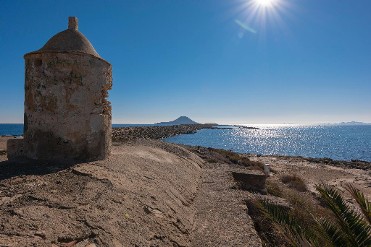
The Estacio Cistern. As in all arid regions, since prehistoric times, humans have devised methods to harness the scarce water resources available, either by storing rainwater or extracting it from the ground through wells. Thus, in the regions of Campo de Cartagena and Mar Menor, the presence of these systems, generally for family consumpiton, is widespread in rural areas, next to homes or scattered in ppulation centers near the beaches. Even lighthouses had their own cisterns, as in the case of Estacio. Introduced by the Romans, it was the Arab who expanded their use. In fact, the word "aljibe" derives from the Arabic term "Al Yibab". They are underground deposits generally in a cylindrical shape, waterproofed with a layer of mortar. On the outside, a wellhead was installed, topped by a small turret or chapel, with a door and a pyramid-shaped roof. Inside the turret, a wooden pulley was placed from which a rope with a bucket hung. The Estacio Cistern, built to supply water to the families and domestic animals of the two lighthouse keepers who provided service to the lighthouse, was constructed following the model of a cylindrical vault and an exrterior turret, very common in the Campo de Cartagena. The storage system began in a pool, collecting rainwater, where it was allowed to settle for some time to remove impurities. The water was channeled from the pool and passed into the cistern through a grille.
LA MANGA CARTAGENA (LA MANGA DEL MAR MENOR)
Cabo de Palos
LA MANGA CARTAGENA (LA MANGA DEL MAR MENOR)
The town of Cabo de Palos, located around the promontory that gives it its name, was originally a fishing village that today continues to combine this traditional activity with tourism, following the birth and development of La Manga del Mar Menor as a destination for sun and beach tourism. The town is organised around its beautiful port, where the fishing boats are mixed with those dedicated to diving, a growing activity, as the Cabo de Palos and Islas Hormigas Marine Reserve has been recognised as one of the best in Europe. The port of Cabo de Palos also has a peculiarity that gives it charm, because unlike the usual, its dock is introduced into the land, since in its construction in the 70s an area called La Charca, low and flooded, was used to place there a safe port and sheltered from storms. From the port starts the Paseo de La Barra, adorned with the terraces of its cafés and restaurants, an ideal place to taste the typical dish of the area: the caldero, made with rice and fish. At the end of this promenade is the Muro de la Sal (Salt Wall), where the boats used to load the precious product obtained from the nearby Marchamalo salt flats. This is the beginning or end of a path that skirts the cliffs of the cape, offering a spectacular landscape of coves, where the blue of the sea contrasts with the dark tones of the rocks, making them ideal for snorkelling, and which takes us to its most emblematic spot: the lighthouse. The lighthouse, situated on a promontory that rises and sinks into the sea, has its origins in the old watchtowers. The 50-metre high tower stands on a square building, which was designed as a lighthouse keepers' school as well as a residence. Its 80 metres above sea level make it the highest in the east and the icon of the whole area. From this strategic point we can dominate the entire coastline, which, starting from Levante Beach and extending towards La Manga, becomes low and sandy. On the way back to the port you should not miss the Plaza de la Virgen del Mar, which is surrounded by whitewashed houses and on summer nights is full of atmosphere on its terraces.
LA MANGA SAN JAVIER (LA MANGA DEL MAR MENOR)
Gran Vía Km. 18
30370 - LA MANGA SAN JAVIER (LA MANGA DEL MAR MENOR)
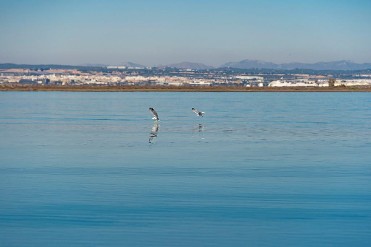
The salt flats consist of a wetland with sandbanks located north of La Manga and are an important part of the Mar Menor, considered a Specially Protected Area of Mediterranean Importance (SPAMI). They cover a total area of 837 hectares and are shared by the municipalities of San Javier and San Pedro. Various local ecosystems can be found, ranging from salt ponds, reed beds, salt marshes, dunes, and channels to fishing enclosures. It is a wetland with sandbanks that borders the south with fishing enclosures and cahnnels that lead to the Mediterranean Sea. In these wetlands, coastal dunes and sandy areas stand out, in addition to sandy bars that cushion the waves in the Mediterranean areas, favoring the presnece of Posiodonia meadows int the seabeds. Te salt flats are located on an ancient marshy area, fromed by a coastal depression filled with Quaternary materials. It is a flat area, with a shallow basin closed by a sandy barrier. In the transition zone between the dunes and the salt flats, salt marshes and small pools with muddy shallows appear, accumulations of remains of marine plants, and small islands, crossed by deeper channels where the fishing enclolsures are located. The movement of water between the Mediterranean and the Mar Menor causes its extensive muddy surfaces to be periodically exposed. A pseudo-tidal character, very rare in the Mediterranean, due to the regulation of water masses by the wind regime, makes this ara of the marine lagoon unique. The flora is represented by the Everlasting and the Sea Lavender in water logged areas; near the beach, Sea Holly and Sea Thistle can be found; in the dune areas, there are Sea Daffodil, Sea Horned Poppy, and Sea Lily; in the more stable dunes, there are Mastic and Blackthorn, as well as Coastal Juniper bushes. Other important presences are Souheastern endemics such as Helianthemum marmenorensis and Frankenia corymbosa, highlighting Senecio joppensis, a rarity in Western Europe. The fauna consists mainly of water brids such as Avocet, Black-winged Stilt, Little Ringed Plover, Little tern, Balck-headed Gull, Sandpipers, Needlefish, Redshanks, and larger birds such as Herons, cormorants, Ducks, Seagulls, and Flamingos, among others. Common reptiles include the Iberian Lizard and the Red-tailed Lizard. Mammals such as the Shrew, Pygmy Shrew, and Weasel are also present, along with a wide variety of bats such as Miniopterus schreibersii, Myotis capaccinii, Myotis myotis, Rhinolophus euryale, and Rhinolophus ferrumequinum. The salt flats harbor endangered species such as the beetle scarities aurytus in the insect family,or the Fartet in the fish family, which is aslo an Iberian endemic. Currently, salt production activities take place in the northernmost part, within the Regional Park of Salinas and Arenales de San Pedro del Pinatar, and its exploitation dates back to Roman and Muslim times, althought it probably began even earlier. Known as the Salinas de Patnía, King Alfonso X incorporates them into the Castilian Crown in 1266, later to be exploited by the Franciscan Order. In 1470, the Murcian Council purchased them and put them under lease, most of the time (1494-1580) being exploited by the Hurtado family. Philip II incorportates them into the Spanish Crown's heritage in 1564 as part of the centralizing policy of resources.
LA MANGA SAN JAVIER (LA MANGA DEL MAR MENOR)
La Manga Norte
30370 - LA MANGA SAN JAVIER (LA MANGA DEL MAR MENOR)
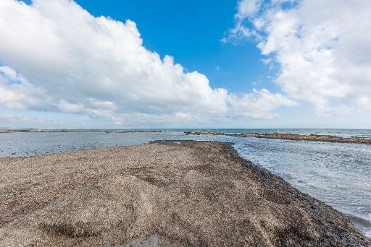
The Mar Menor is a coastal lagoon connected by channels, called "Golas", through which water is exchanged with the Mediterranean Sea. Located in the Encañizada area, near the Veneziola site, north of La Manga, the Gola del Charco is, along with the Ventorrillo Gola, one of the two natural channels that are preserved, out of the five that exist in La Manga. In this channel, as in the Ventorrillo Gola, to take advantage of the migratory movement of some fish such as mullet, sea bream, leerfish, or cutlassfish, elaborate fishing systems made of reeds and nets, called "encañizada", have been installed since arab times, which have given the area its name. The Gola del Charco, like the rest of the Encañizadas area, has undergone few transformations, except for the islets of Ventorrillo and Torre, which house auxiliary buildings for fishing facilities. The habitat of the area where the Gola del Charco is located is formed by an extensive zone of halophytic vegetarion, dunes, beaches, and accumulations of oceanic Posidonia seaweed. This area becomes flooded when there are the infrequent rains or a storm. It is also the refuge for stilts, avocets, and other birds of great interest and rarity such as the Great Crested Grebe (Podiceps cristatus) and the Red-breasted (Mergus serrator)
LA MANGA SAN JAVIER (LA MANGA DEL MAR MENOR)
Km. 18
30380 - LA MANGA SAN JAVIER (LA MANGA DEL MAR MENOR)
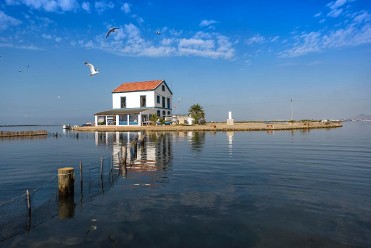
La Encañizada is a wetland located between the southern edge of the Regional Park of Salinas and Arenales de San Pedro del Pinatar and the Veneziola area, north of la Manga. It is one of the protected natural spaces that still retains a significant portion of its original values and forms. At the boundary with the Mediterranean, a series of reefs or small bariers stand out. On the other side, next to the Mar Menor, two small islets, El ventorrillo and La Encañizada, the latter having had a defensive tower since the 16th century, which was demolished in 1938. These islets are traversed by two golas or communication channels, Gola de la Torre and Gola del Ventorrillo, the only natural ones that remain of the five that exist in La Manga. In these two golas, to take advantage of the migratory movement of some fish such as mullet, sea bream, leerfish, or flathead grey mullet, elaborate fishing systems have been installed since the Arab period. These systems, made with reeds and nets, are called "encañizadas", which have given the area its name. They are usually located in shallow waters and shifting sandbars. These two encañizadas belonged to the State, which leased them through public auctions. Today, the encañizada of Gola de la Torre is still in operation. The surroundings of the encañizada are a transit, resting, and nesting area for multitude of water birds such as flamingos, herons, and avocets. Encañizada de la Torre. It is the only one preserved in the entire Mediterranean Sea and is located in the Veneziola ara north of La Manga and south of the Regional Park of Salinas de San Pedro. The building was constructed in 1509, and of the five encañizadas that were operational in the 1950s and 1960s, la Torre, after several restorations, is the last one still in operation, in a protected natural space that still preserves its original forms. This fishing technique of encañizadas, originating from the Arab period, boasts six centuries of artisanal fishing. Encañizadas fishing involves placing canes in circular labyrinths in water channels between the Mar Mayor and the Mar Menor so that passing fish become trapped in the maze, especially sea bass and sea bream that emerge after spawning in the warmer waters of the Mar Menor. The last owner of the concession from the State is "Pescados Albaladejo". In the background is the encañizada of Ventorrillo.
LA MANGA SAN JAVIER (LA MANGA DEL MAR MENOR)
LA MANGA SAN JAVIER (LA MANGA DEL MAR MENOR)
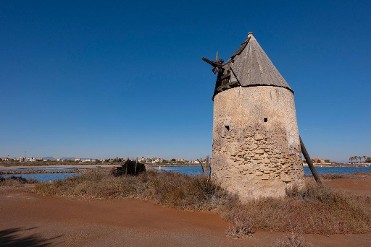
The salt Windmill of Veneziola, which still displays its spire and part of its machinery, was built very close to the sea to facilitate the transfer of water and propel it to the detection pools where it was left to evaporate, thus obtaining salt. Salt mill windmills typically have a height ranging from 8 to 12 meters. The diameter of their circular base is between 6 and 10 meters. The upper part or roof is called the spire, and the blades that originated from it could measure from 10 to 14 meters, and on them, sails were attached. Like the boats of the local fishermen, these sails had a Latin shape, giving them one of their most distinctive features. This mill does not have the typical windows along its body; instead, a single opening appears on the front face, which served as the entrance to the machinery. Originally, it must have been made of wood, and only the frame remains today. In general, windmills consist of a series of wooden and iron gears that transmit the energy generated by the sails, driven by the wind. This one in La Manga preserves all that gear, and although not in very good condition, it continues to attract the attention of numerous strollers. The introduction of modern systems in salt processing work led to the abandonment of these ancient systems, leaving them today exclusively as tourist attractions.
LA MANGA SAN JAVIER (LA MANGA DEL MAR MENOR)
LA MANGA SAN JAVIER (LA MANGA DEL MAR MENOR)
The salt mills crushed the salt clumps extracted from the salt pans of the Mar Menor. On their blades, which could measure between 10 and 14 meters, Latin sails were tied, identical to the sails used by the fiserment of the Mar Menor on their boats. In the salt pans, other types of mills could also be found, whose function was to extract seawater and transport it to the resevoirs of the salt pans. These mills were built very close to the sea to facilitate the transer of water and allow it to evaporate to obtain salt. As examples of these two uses, we find the mills in Pudrimel, one for lifting water and the other for grinding salt. Of these two mills, only the tower is preserved. Both types of salt mill now bear witness to the economic importance that the salt industry and trade had in the region.
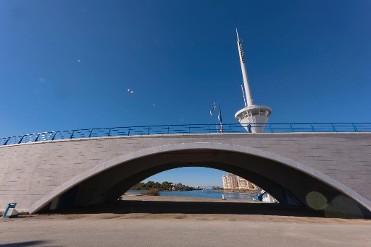
LA MANGA SAN JAVIER (LA MANGA DEL MAR MENOR)
Gran Vía de la Manga Km. 13
30380 - LA MANGA SAN JAVIER (LA MANGA DEL MAR MENOR)
The bridge that crosses the Estacio Canal is a significant engineering feat, serving as the only land communication route connecting Veneziola to the rest of La Manga. Initially, an ingenious vertically pivoting bridge was designed, with its pivot point supported by a concrete mass located in the canal bed that serves as the passage for vessels navigating between the Tomás Maestre port and the Meditetranean. Due to its progressive deterioration and the need to expand the road traffic lanes (the old bridge had only one lane), a decision was made to construct a new movable bridge with greater capacity and reliability. This new bridge aims to address the existing problems, both with the bridge itself and those associated with maritime traffic.


